
The lift doors close with a soft finality, sealing off the noise below. As it ascends, the transition is gradual. There is no sudden reveal, just a quiet awareness of movement, a shift upward that feels both physical and anticipatory.
When the doors open, the first sensation is space.
Air feels lighter here, carrying traces of the city and the open sky.
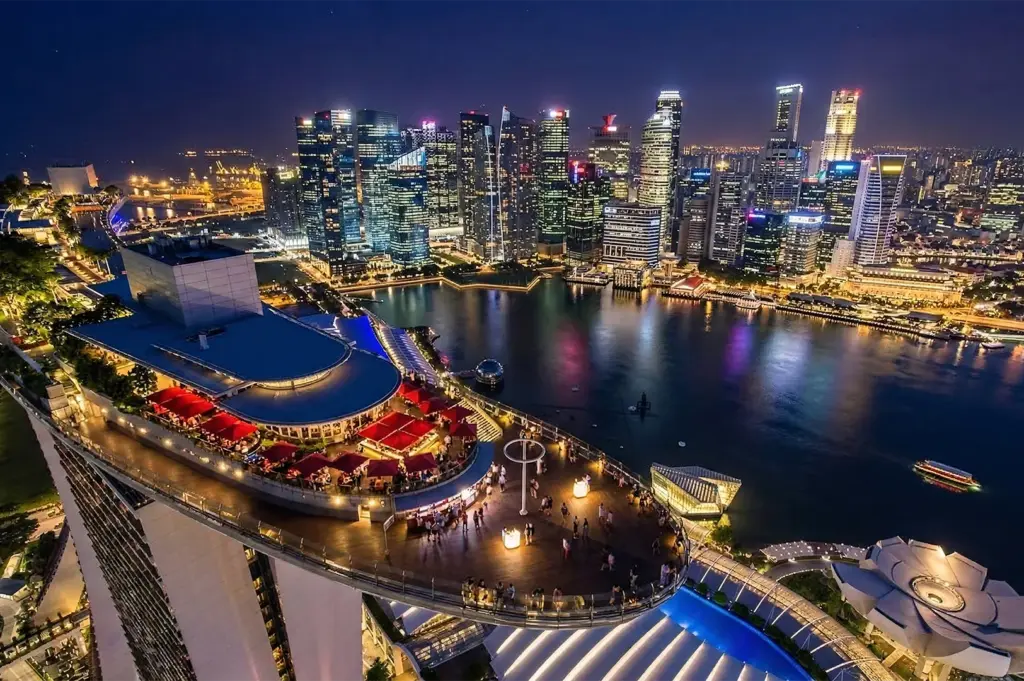
Stepping onto the rooftop, the skyline presents itself without ceremony. Marina Bay stretches outward in clean lines, water, glass, and light held in quiet balance. The bar does not compete with the view; it simply frames it. Seating follows the edge, drawing attention outward. I pause briefly, letting the height settle before moving further in.
Early evening holds a certain restraint. Conversations remain measured, movements unhurried. Guests arrive in small groups, easing into the space.
Service mirrors this rhythm, present, but never intrusive. Staff move with familiarity, not performance.
Light fades gradually.
Not a moment, but a process.
The skyline shifts as buildings begin to glow, and the city redraws itself in light.
By mid-evening, the tempo changes. The space fills, and conversations begin to overlap. Movement becomes more continuous, though never chaotic.The bar gathers quiet density. People move toward it, then away again.
Even at its busiest, the space holds. There is room to move, to pause, to look outward. Nothing feels compressed.
Later, the energy softens. Groups thin, voices lower, and the rhythm slows. The skyline remains constant, anchoring the room as it settles. The height no longer feels distinct, it simply exists.
Leaving follows the same path, though the descent feels quicker. The noise returns, but something of the rooftop lingers.Not as a single moment, but as a quiet sequence of rooftop revelry, one that extends into the broader experience of the complex, explored further in Where to Dine at Marina Bay Sands.